A
MADAGASCAR ADVENTURE
In November 2015 we participated in a month
long tour of Madagascar, this was a package tour with specialist birding
company Rockjumper Birding Tours. The first response we give when asked about
the tour is that it was very tough with lots of steep walking through
rainforest, it was hot and the general standard of accommodation and food was
generally very basic. Our next response is that the birds and mammals
(particularly the Lemurs) are amazing and well worth the very long journey.
In order to break our journey to Madagascar
we flew from Perth to Mauritius for a couple of days. Mauritius has only 10
endemic birds remaining due to extensive land clearing and the introduction of
rats, cats and shrews. Ile aux Aigrettes is a small island reserve well worth
visiting which is home to a breeding centre for birds and endangered skinks and
tortoises. Here we were able to see Pink Pigeon, Mauritius Olive White-eye and
Mauritius Fody. Interestingly the Madagascan Fody has been introduced to the
island and is more commonly seen than the Mauritius Fody. In the south of the
island the forests of the Black River National Park are well worth visiting and
we saw White Tailed Tropic Birds soaring on thermals in the canyons, Mauritius
Grey White-Eye, Pink Pigeon and the introduced Rose winged Parakeet.
Unfortunately we didn’t find the endangered Mauritius Parakeet.
 |
| Pink Pigeon - a Mauritius Endemic |
Once we arrived in Madagascar our first
destination was the Masaola Peninsula on the north east coast, this remote national
park of 240,000 hectares contains the largest remnants of rainforest in
Madagascar and as a result is the best place to see some very special birds and
Red Ruffed Lemur. Travel to our lodge involved a two and half hour flight in a
charter plane, a two hour journey in a small boat across the bay. From our
lodge to reach the primary rainforest we travelled first by dugout canoe and
then walked up and over many ridges and through numerous creek crossings. The
object of our walk was to see Helmet Vanga a truly amazing bird and our local
guides took us right to where a pair where nesting, seeing them at length made
all of the journey worthwhile. Other bird highlights included Scaly Breasted
Ground Roller, Red fronted Coua, Blue Vanga, Rufous Vanga, etc. Unfortunately
our views of Red Ruffed Lemurs were fleeting with a group feeding high in the
canopy on a very precarious slope.
 |
| Helmeted Vanga |
Our next destination was Berenty Private Reserve
which encompasses gallery rainforest along a river and adjoining patches of
spiny forest. Berenty is home to Ring tailed Lemurs and the famous dancing
Sifaka (Verreaux’s Sifaka) both of which can be seen right outside your room.
Here it was very hot 42C so birding was restricted to early mornings and late
afternoon. The dry rainforest is home to the very vocal Giant Coua, Grey headed
Lovebird, Madagascar Paradise Flycatcher, White browed Owl, Madagascar Cuckoo
Hawk and Madagascar Scops Owl.
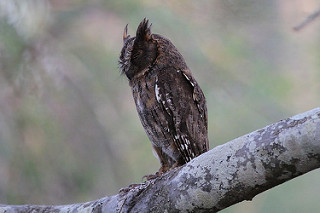 |
| Madagascar Scops Owl |
The unique landscape of the Spiny forest dominated
by waving Octopus Trees and Baobabs contains a diverse range of specialists
including the Running Coua, Crested Coua, Madagascar Scops Owl, Sakalava
Weavers and Carol’s favourite Mouse Lemurs.
 |
| Giant Coua |
 |
| Verreaux's Sifaka |
Moving on from Berenty we travelled to the
west coast near Ifaty to another patch of Spiny Forest where the local guides
have an intimate knowledge of where each bird is located and will often
disappear into the forest to herd birds back right to your feet! This is where
you can get great views of the striking Long tailed Ground Roller, Running
Coua, Subdesert Mesite, Madagascar Button Quail, Sickle Billed Vanga and
raptors such as Madagascar Harrier Hawk, Madagascar Sparrowhawk, Madagascar Kestral
and Banded Kestral. Off shore from nearby Tulear we travelled by small boat to
Nosy Ve (a small coral cay) which is the best place to view Crab Plovers and
nesting Red tailed Tropic Birds. The beach here was amazing with white sand
covered by seashells of every type and size you can imagine. Our views of Crab
Plovers were distant as they were very shy, the Red tailed Tropic Birds however
circled right up close and you could getting some amazing photos.
 |
| Long-tailed Ground Roller |
Leaving the coast we travelled by road
through the middle of island which is very tedious given the poor state of the
roads and rather depressing looking given the wide scale clearing of forest for
charcoal which is the main source of cooking fuel. Along the way we stopped off
at several remnant forest areas to look for localised birds.
The highlands of Ramanofana were a welcome relief
after the heat of the lowlands and the national park contains some extensive
patches of protected rainforest dominated in many areas by extensive stands of
bamboo. The trail network here was very good which made climbing the steep
ridges a bit easier. This rainforest contains some mouthwatering birds including
Pitta Like Ground-Roller, Velvet Astity, Sunbird Astity, Green Sunbird and
mammals such as Bamboo Lemurs, Pygmy lemurs, Milne Edwards Sifaka and the
spectacular White Ruffed Lemur. Nocturnal walks here featured Chameleons, frogs
and Mouse Lemurs.
 |
| Pitta-like Ground Roller |
 |
| Pitta-like Ground Roller |
 |
| Sunbird Asity |
Travelling back by road to the capital Antananarivo
and then by air to the west coast city of Morondava we travelled inland to
Ankarafantsika National Park. Here the deciduous dry rainforest is home to an
assortment of very desirable birds including Van Dam’s Vanga, White breasted
Mesite, Red capped Coua, Coquerel’s Coua, Greater Vasa Parrot and Schegals
Asity with the adjoining wetland home to Madagascar Fish Eagle, Madagascar
Jacana, Humboldts Heron and Allen’s Gallinule. Coquerel’s Sifaka a stunning
chocolate and white Sifaka is common in the campground and can be readily seen.
 |
| Madagascar Paradise Flycatcher |
 |
| Coquerel’s Sifaka |
 |
| Indiri |
Returning back to the capital we then
travelled to Mantadia National Park and adjoining Andasibe (Perinet) Special
Reserve. The rainforest here is famous for Indiri or singing lemur and the
haunting sound of their calls could be heard from our lodge and up close in the
forest their calls are deafening. The beautiful Diademed Sifaka with it’s two
toned coat was also encountered several times whilst walking through the
forest. This is the best locality to see Short legged Ground Roller which is
very cryptic and is located primarily by its call. If a bird is calling it
means it is perched and necessitates a mad scramble through the forest before
it stops calling, after a frantic race across creeks through vines and uphill
we had cracking views. Madagascar Pygmy Kingfisher is a rainforest specialist
and we managed to see several of these stunning Orange and white Kingfishers.
Other highlights here included Nuthatch Vanga, Blue Vanga, Rainforest Scops
Owl, Madagascar Crested Ibis, Madagascar Long Eared Owl, Madagascar Wood Rail
and White Throated Rail. A nocturnal walk in the rain yielded some stunning
tree frogs, assorted lemurs and beautiful Chameleons.
 |
| Scaly breasted Ground Roller |
 |
| Madagascar Pygmy Kingfisher |
Our final destination was the central
highlands of Anjozarobe which lived up to its name with every walk straight up
some very steep ridges. At the top of one of these ridges in what could be
described as dwarf bamboo cloud forest we found the diminutive Brown Emutail.
Only birders would travel so far to see a very tiny plain brown bird! Fortunately
it responded well to playback and came out of the dense undergrowth long enough
to give us a good look. Just around the corner we finished off our quest for
all of the Ground-Rollers with a Rufous Ground-Roller with its necklace of blue
with white spots giving us a real boost for the return walk. Our last nocturnal
walk of the trip gave us our only leaf tailed Gecko of the trip and what an
amazing Gecko they are so well camouflaged it’s no wonder they are so hard to
find. We shared our room here with Pygmy Lemurs which emerged from the roof
each night at dusk and returned dashing across our verandah each morning just
before dawn.

The wetlands of Madagascar have been largely
drained or transformed into rice paddies and as a result many of the wetland
birds are struggling to find sufficient habitat to survive. We were lucky
enough at our stops at several small wetlands to see Meller’s Duck, Madagascar
Grebe, Madagascar Kingfisher, Malagasy Pond Heron, Black Heron, Greater Painted
Snipe and Madagascar Jacana.
Overall we managed to see 175 bird species
including nearly all of the endemic bird species possible on the tour and 21
species of Lemur and 9 species of Chameleon. Madagascar with its high number of
endemic species is one of those destinations should be on any birders' bucket
list.
Steve & Carol Popple


